
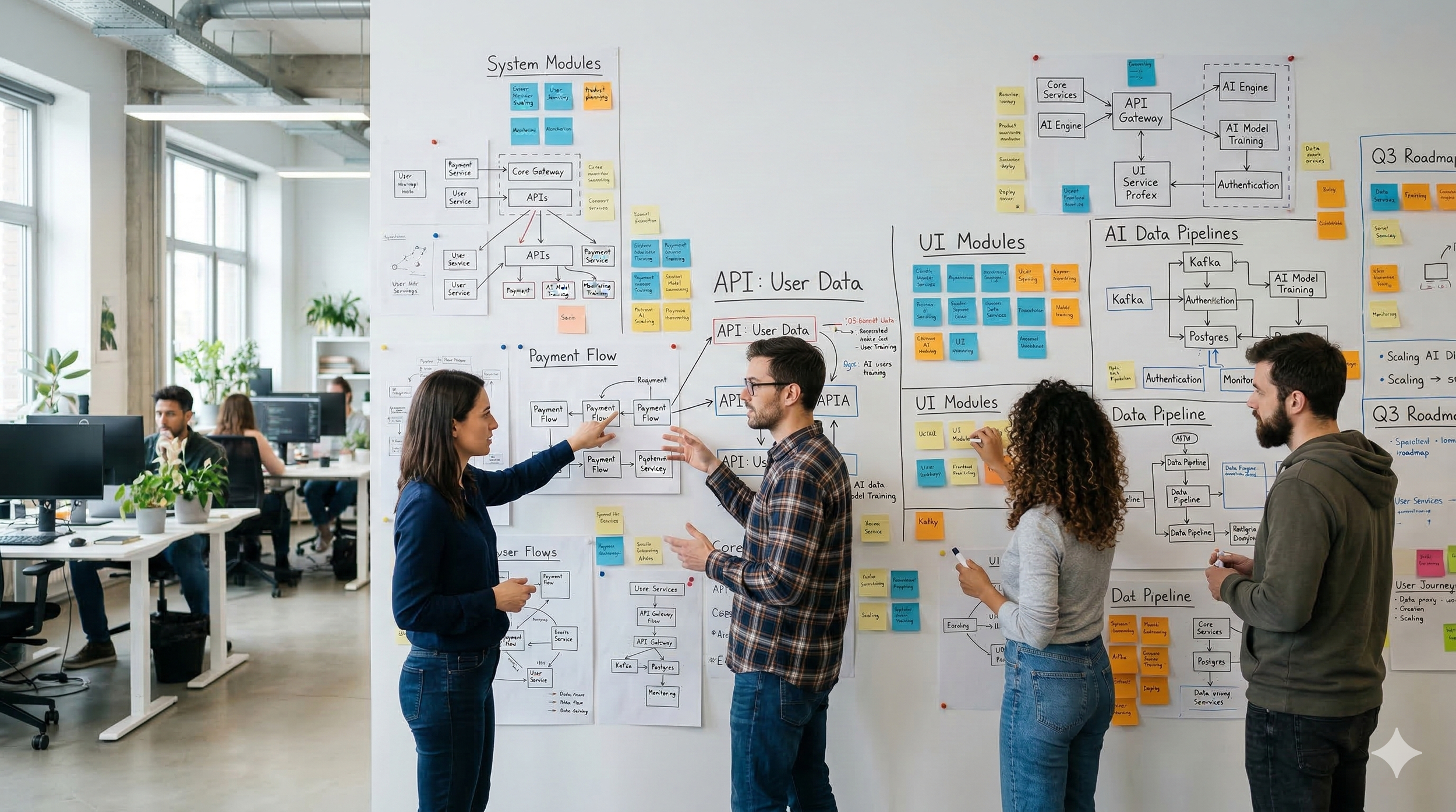
From evidence to operating architecture.
Our work is grounded in three disciplines that ensure software decisions are validated before they are built.

Validation-Driven Engineering
We begin with evidence. Before building, we validate assumptions, workflow friction, data potential, and decision constraints. Speed without validation creates structural debt.
Intelligence-Centric Architecture
We design systems as learning environments. Data flows are intentional. Feedback loops are embedded. Intelligence operates across the core — not as a feature layered on top.
Responsible Agility
Execution is governed. Architecture leads delivery. Compliance and measurement are built in so growth increases clarity — not risk exposure.
What we do not do.
Our approach is designed to preserve structural integrity. These boundaries protect outcomes as complexity grows.
- We do not implement isolated tools without architectural clarity.
- We do not optimize for feature velocity at the expense of structural integrity.
- We do not treat AI as a marketing layer or a shortcut to transformation.
How engagements progress.
While every organization is different, our work follows a structured progression designed to preserve coherence and reduce execution and decision risk.
Frequently Asked Questions
Common questions about how we work and when it makes sense to engage.
Do we need a fully defined product idea before engaging?
No. Many organizations come to us because they are unsure what to build next. Our process begins by validating the problem, workflow, and opportunity before development begins.
Can you work with our existing software systems?
Yes. Many engagements involve improving or evolving existing systems rather than replacing them. We focus on understanding the current architecture and identifying where improvements will create the most impact.
How long does the validation phase typically take?
It depends on the complexity of the problem, but validation usually takes a few weeks. The goal is to reduce uncertainty before committing to development.
Do you only work on AI-related projects?
No. We work on business systems where automation, data, or intelligent workflows can improve operations. AI is used when it creates measurable value.
What happens after the system is built?
After delivery, we measure outcomes and continue improving the system over time. The goal is to ensure the software evolves as the business grows.